
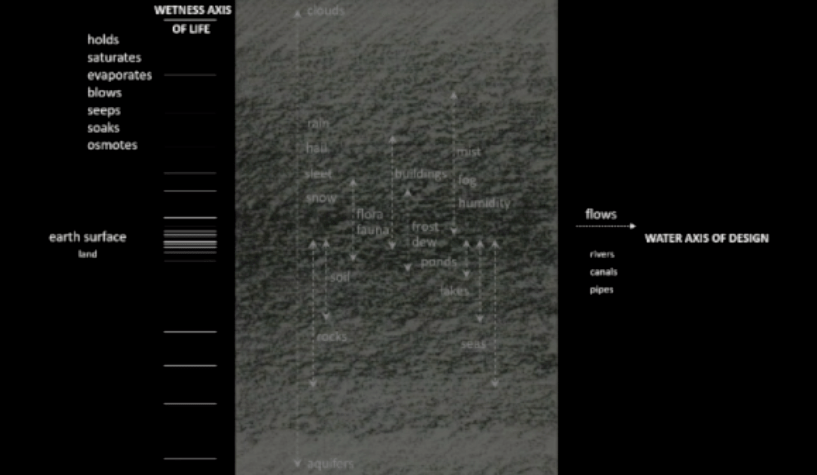
Design as a series of investigations based on conditions for accommodation rather than fixed assertions. To think of land as more or less wet, and that there is no such thing as dry changes the relationship that we have to land – it is not a fixed condition. This changes the relationship that we have with landscape – water is no longer contained, as to contain would be to accept the relationship that it has with land as fixed- that land is what dictates the form of water. Rather this form is actually a moment of containment; any instance of a flood would be proof of this. Design needs to operate in this space of transition rather than of permanence.
Another point that I thought was worth thinking about was the idea that the ground surface is not an end in itself but rather a middle-ground, literally a space for negotiation. The semantics of this is too metaphorical however, what does it mean to treat the ground as a mediator? How does it go beyond words?
One’s attitude to monsoons can be compared to our current attitude to the pandemic. Are we just to see it as an isolated event, where things will “go back to normal” when it has passed? Or are we to see it like how tropical countries like Singapore has built structures to accommodate the monsoon, seeing it as an integral part of the climate? This is like how London is infamous for its gloomy weather; while in Providence a gloomy day is a bummer, in London it is just treated like another day. When did sunny days get priority over gloomy days? What are the implications of such an attitude of embracing fluctuation – is permanence ruled out completely or is it just seen as an exception?
What are the consequences of permanence over time?
/shiftposter
Image credit: Anuradha Mathur and Dilip Da Cunha from their lecture “Design in the Critical Zone Between Clouds & Aquifers”
 full-of-shift.com